Bundles of energy that bundle energy: cleaning technology “sees the light”
“With great professional commitment, courage to take risks and staying power, they have realised the vision of an ecological cleaning technique using light as a medium. With their great readiness to accept responsibility, their extreme motivation and their initiative, they have turned their firm, in an ecologically and economically exemplary fashion, into a technological world leader, and tangibly improved worker safety in the companies that use their system.” – This is how Dr.-Ing. E. h. Fritz Brickwedde, Secretary General of the Deutsche Bundesstiftung Umwelt (DBU) today recognised the presentation of the DBU’s 2010 German Environmental Award to the partners and co-founders of the company Clean-Lasersysteme (Herzogenrath), Dr Winfried Barkhausen (51) and Edwin Büchter (41). German President Christian Wulff will present them with the award – the most lucrative environmental prize in Europe – in Bremen on October 31. They will receive 245,000 euros in prize money.
When technical surfaces are cleaned, dust, noise and offensive odours are part of normal procedure
Considerable quantities of environmentally-harmful and health-damaging solvents, poisonous gases, particles that drift freely through workshops and factories – this is often par for the course even today when technical surfaces are cleaned using chemical, mechanical or thermal methods, Brickwedde said, with dust, noise and offensive odours part of normal procedure.
New laser technique can be integrated into the production process
He said that the laser technique developed by Barkhausen and Büchter, which uses “light as a cleansing agent”, enabled “debris” that was removed to be sorted cleanly and sometimes even recycled. Brickwedde described how, up to now, components that were to be screwed, welded, riveted or glued together needed to be completely cleaned to prepare them – resulting in large quantities of waste and cleansing agents that had to be disposed of. Now, he said, it was enough to clean only the places that were to be connected; moreover, this could be integrated into the production process. He said that such industrial cleaning processes were usually carried out away from the production line because of the use of problematic agents or the time taken for cleaning. At the start of the millennium, he said, Clean-Lasersysteme had developed the first mobile industrial apparatus for manual laser cleaning in the world; over 200 systems were now being used, for example at Audi, Airbus or in smaller industries such as the Oexmann waffle bakery (Gelsenkirchen).
Much easier on the environment and resources to clean old utility poles with light as a cleansing agent
Brickwedde described how the special characteristics of light as a cleansing medium made it possible to develop applications for which there had formerly been no satisfactory technical solutions. For example, he said, electrical companies had the problem of replacing old utility poles whose corrosion protection was beginning to fail owing to decades of weather exposure. Brickwedde: “Of course, that’s possible. But it would be much easier on the environment and resources to clean them where they are using laser rays and then to be able to sort and collect the harmful debris that is removed as well.”
Energy consumption can be reduced by up to 87 percent compared with conventional procedures
Brickwedde noted that the technology of Clean-Lasersysteme also had considerable financial advantages. He said energy consumption could be reduced by up to 87 percent compared with conventional procedures. According to Brickwedde, savings of altogether 70 percent were possible – including the improvements in quality. Brickwedde: “No other technology can demonstrate this quality of cleaning.” At any rate, he said, the procedure, the company and its product were certain to gain increasing social relevance.
Laser cleaning is “a quantum leap in technology”
Particularly with regard to environmental protection, Brickwedde said, laser cleaning was “a quantum leap in technology”. And not only that: investment in modern environmental technology led not only to better protection of the environment, but opened up big market opportunities for technologies and products developed in Germany and thus created jobs. Brickwedde noted that the possibilities for application and marketing and the associated reduction in pollution were “very considerable” both nationally and internationally for Clean-Lasersysteme and its technology: “With their purposeful attitude, their competence in solving problems, their treatment of workers in their company and their modern corporate concept, Winfried Barkhausen and Edwin Büchter represent for me a modern, innovative company with modern leaders. They are business personalities that set an example.”
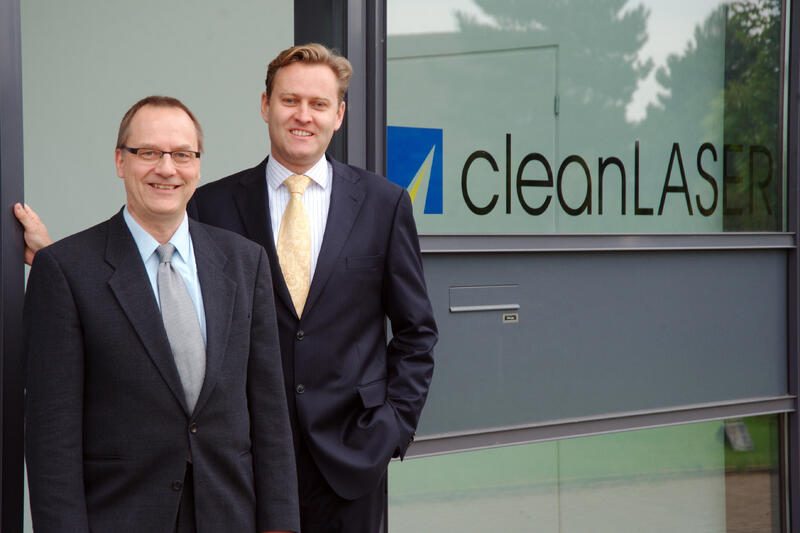
© Andreas Herrmann/DBU