Development and implementation of an educational program on the topic of “climate crisis” for schools
Cover picture: Fig. educational materials Borrowed Planet Climate Change
Keywords: environmental communication, climate crisis
Subject matter and objectives of the project
Unfortunately, courses in the context of education for sustainable development are the exception in Slovakian schools. Many teachers do not have the necessary specialist skills to adequately teach environmental and sustainability topics and integrate them into the curriculum. There is also a lack of suitable teaching materials and new didactic concepts for lessons. The aim of the project is therefore to develop and implement an innovative educational program for schools that focuses on the topic of climate change and teaches it in the context of education for sustainable development in a practical and target group-oriented manner. The aim is to present both the expected consequences of worsening climate change and the real changes that have already occurred as a result of climate change, as well as the negative effects on natural ecosystems and the environment. The aim is to enable students to understand the connections between local and global climate events, to classify the consequences of human action and to critically reflect on their own lifestyle with a view to taking responsibility. Finally, suitable examples will be used to demonstrate options for sustainable action and provide incentives for implementation. In addition to the publication of a book with 16 stories on the topic of “climate change/climate crisis”, four workbooks for use in school lessons, an educational handbook and eight seminars and webinars each for teacher training are to be developed, tested and disseminated. A professional media company, the Faculty of Natural Sciences at the Philosoph Constantine University in Nitra and the registered association “Geliehener Planet für Schulen” are to be involved in the implementation of the project. In total, the project is expected to reach around 180 – 240 pupils from grades 4 and 5 as well as 6 to 9.
Work steps:
- Elaboration of the four story themes for the book of stories: Borrowed Planet – Climate Change, printing of the 1st edition of 2300 copies (approx. 148 pages, format 18×24 cm, 16 stories), distribution of the publication to schools,
- Development of environmental education activities for workbooks for pupils (grades 4-5), print, approx. 148 pages, format 18×24 cm, (2300 x 4 = 9200 pcs.)
- Development of 32 environmental education activities and tasks for the handbook for pedagogical practice for teachers and pupils (grades 6-9), approx. 148 pages, format 18x24cm, 32 environmental activities (8 on each topic)
- Evaluation of the developed publications by testing the materials in teaching practice at pilot schools, revision of the publications by the project partner TÖH e.V. and evaluation by external experts, graphic design and language editing of the publications, certification of the publications by the Ministry of Education, Science, Research and Sport of the Slovak Republic,
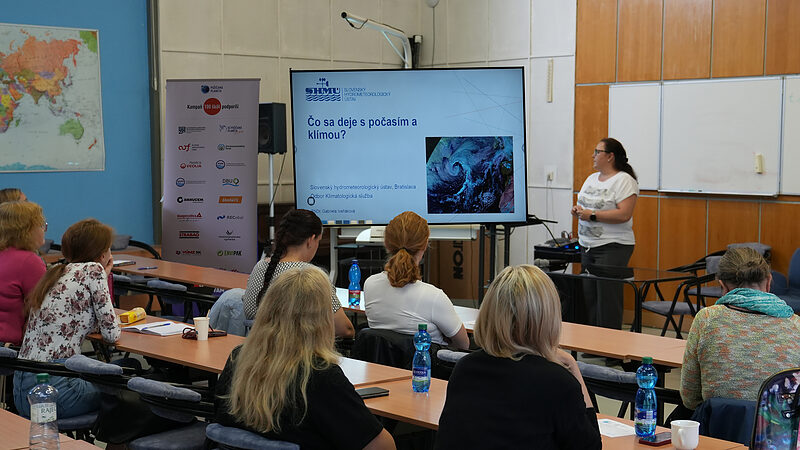
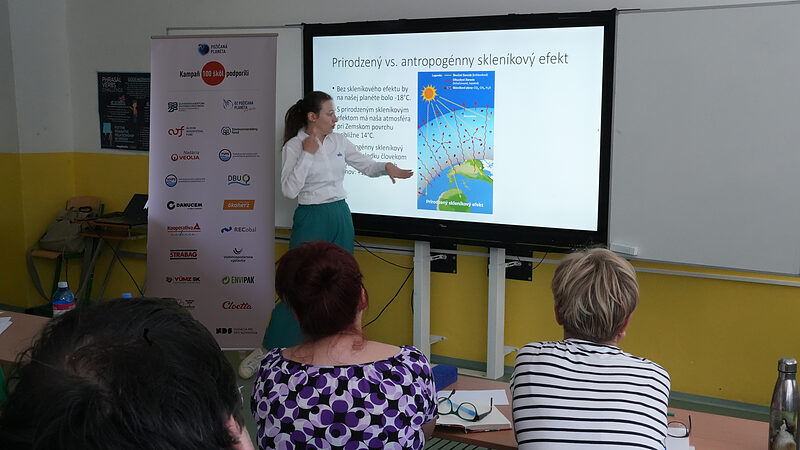
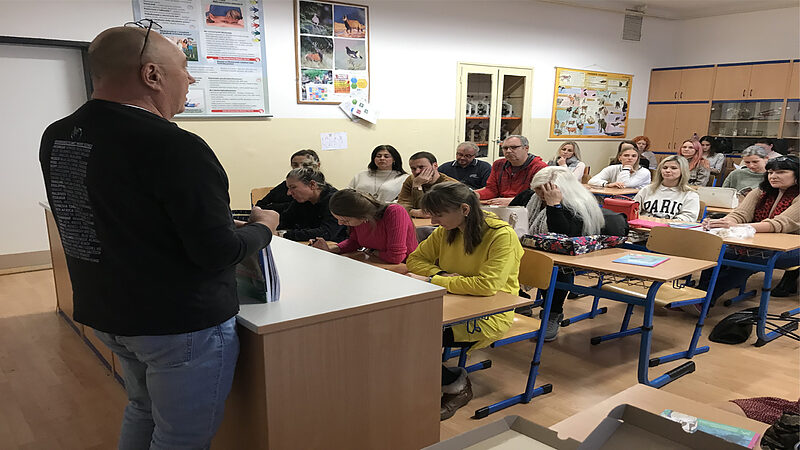
- Implementation of educational materials based on the implementation of the innovative training program in 12 pilot schools (12 classes with 15-20 students – a total of approx. 180-240 students and 24 teachers from grades 4-9) in various Slovak cities, each of which will involve two teachers. The project is being implemented in cooperation with the National Institute of Education and Youth, the Ministry of Education, Research, Science and Sport of the Slovak Republic.
- Organization of four conferences for approx. 200 teachers, 8 training seminars for approx. 160 teachers and 8 webinars for approx. 120 teachers, multipliers and stakeholders in formal and non-formal education,
- Dissemination of the project results via various dissemination channels: Website Pozicana planeta https://pozicanaplaneta.sk/ (Borrowed Planet), social networks, newsletter, online portal for environmental education Ewobox, participation in various thematic and educational events, e.g. conferences, seminars, workshops; networks of partners in the field of sustainability and education,
- Project management and international cooperation
Innovation and exemplary nature of the project
The project is designed, structured and implemented in such a way that it is transferable as a whole or in parts. This enables implementation not only in the Slovak Republic, but also in other Central European countries. In this way, cooperation and networks can be established between foreign organizations working in the field of education for sustainability.
The structure of the program also serves as a model that can be transferred to the creation of materials on similar topics using methodological and didactic means such as storytelling. Based on the findings, environmental education activities can be prepared and thus activation processes in education can be stimulated. Ideally, these will bring about changes in the attitude or behavior of the pupils and thus also their environment. By using various didactic means and methods in the work with the target group, a uniform and comprehensive approach and treatment of the topic of sustainability is achieved.
The applicability of the structure can be particularly useful for other institutions and organizations involved in environmental education. According to the analysis of formal environmental education in the Slovak Republic, the implementation of environmental education in the practice of the formal component of educational content does not guarantee the effectiveness of the educational process. The deficits are mainly in the areas of content and methods, networking of cross-cutting issues, opportunities for extracurricular activities and systemic support of responsible educators. The project is innovative above all because it is complex and uses modern elements such as stories, environmental education activities and documentary films that complement each other. This diversity makes it possible to vary the forms and methods of teaching. The result is an appealing and understandable environmental education.
Special aspects of the project
…
Project implementation:
Thüringer Ökoherz e. V., Weimar,www.oekoherz.de
dive 2000 production GmbH, Nitra Slovak Republic, https://pozicanaplaneta.sk
Associated partners:
University of Philosophy and Constantine in Nitra, Faculty of Natural Sciences, Slovakia, https://www.ukf.sk/en/
Geliehener Planet für Schulen, e.V. Nitra, Slovakia
Places of work: Germany, Thuringia Slovakia
Funding period: 01.01.2023 – 30.06.2025 (30 months)
Project costs: Total volume: 215,541 euros, funding from DBU: 124,958 euros
Status: 01.07.2025