“Conviction, perseverance and innovation”
Osnabrück/Aachen. The 2026 German Environmental Prize, totaling 500,000 euros, will be awarded today (Sunday) in Aachen, with equal shares going to membrane filter engineer Dr. Klaus Vossenkaul, founder and managing director of the Roetgen-based company Membion, and to Hamburg-based environmental lawyer Dr. Roda Verheyen. Presented this year for the 34th time by the German Federal Environmental Foundation (DBU), the award is one of the most highly endowed environmental prizes in Europe and will be presented by Federal President Frank-Walter Steinmeier during a ceremony beginning at 11 a.m. The two honorees are “inspirational figures who show how positive progress can be made,” said DBU Secretary General Alexander Bonde. He added: “Roda Verheyen and Klaus Vossenkaul embody conviction, perseverance, and innovative spirit with a clear compass when it comes to environmental and climate protection—which also serve as location factors for companies in Germany.”
Bonde: Environmental economy as the nation’s job engine
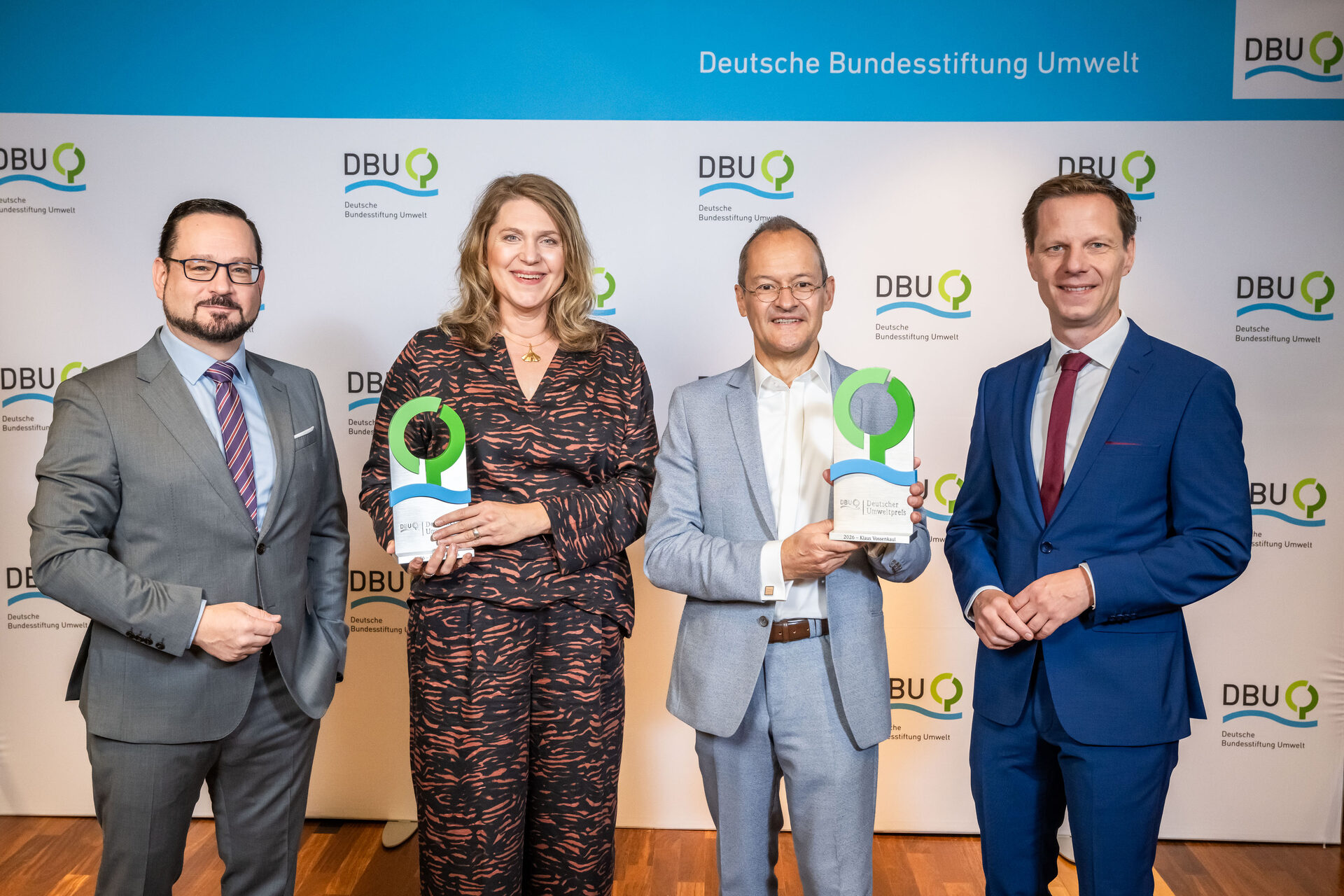
Bonde urges people to “actively seize environmental and economic opportunities, especially in these challenging global times. We need a fresh start, and we have what it takes.” The environmental economy could become “the nation’s job engine.” According to Bonde, “climate, nature, and resource protection creates jobs and ensures prosperity. GreenTech made in Germany has the potential to be a major export hit.” To achieve climate goals such as climate neutrality by 2045—which is enshrined in German law—“we urgently need investment, ideas, and a clear legal framework.” DBU Board of Trustees Chair Prof. Dr. Kai Niebert: “The two award recipients prove that the future is forged in garages and courtrooms. After all, progress requires innovation and the freedom to demand change.”
Innovations in wastewater treatment and a tireless commitment to greater environmental and climate justice
Membrane filter engineer Vossenkaul and environmental lawyer Verheyen are being awarded by the DBU with the 2026 German Environmental Prize for precisely this reason. Klaus Vossenkaul, whose company Membion literally started as a garage business, is “a pioneer of innovative solutions in wastewater treatment and is thus making a significant contribution to the conservation of water, a vital resource,” says Bonde. “The record-breaking heat of the summer of 2026 has made it clear just how relevant this will be in the future.” According to Bonde, enforcing the appropriate legal requirements is essential for greater environmental and climate justice. “Roda Verheyen has worked tirelessly toward this goal for more than two decades.”
Niebert: Today we are also celebrating the strength of democracy
Verheyen works as an attorney in Hamburg, where she is also a member of the Hamburg Constitutional Court. Ensuring the environment gets its due: This motivation has been a constant thread throughout Verheyen’s entire professional life. DBU Board of Trustees Chair Niebert puts it this way: “In Roda Verheyen, we are honoring a strong lawyer who has been advocating for the foundations of our lives for decades.” She is a courageous advocate for climate and environmental protection and demonstrates “what makes our constitutional state strong: that citizens can not only criticize government action but also have it corrected by the courts,” says Niebert. According to him, “those who challenge the state in this way do not weaken it—but rather take it at its word.” This is a “strength of our democracy that we are celebrating today with Roda Verheyen,” says Niebert. Landmark legal decisions are closely associated with Verheyen’s name, such as the Federal Constitutional Court’s climate ruling, which held that insufficient climate protection violates the civil liberties of future generations. Verheyen does not want to see herself limited to the role of plaintiff by any means. Rather, she sees herself as an “enabler” whose goal is to equip the state with the necessary legal tools and thus prepare it to face the challenges of the climate crisis. With this level of commitment, she enriched the nonpartisan initiative for an effective state under the patronage of Federal President Steinmeier following her appointment.
“Environmental protection can be a driver of innovation”
Dr. Klaus Vossenkaul, a membrane filter engineer, holds 28 patents and, in Bonde’s words, “has set new standards in wastewater treatment.” The membrane filter technology for wastewater treatment plants that he has further developed paves the way for an energy-efficient and space-saving treatment system using hollow-fiber membranes. These are thin tubes that, when used in wastewater treatment plants, filter crystal-clear water from the sewage sludge. They look like spaghetti, are hollow like macaroni, and are about 1.60 meters long. Fine pores in the membranes filter problematic substances such as microplastics, pathogens, and multidrug-resistant bacteria out of the wastewater. According to Niebert, Vossenkaul demonstrates “how inventive spirit can lead to economic success. The technology he developed makes it clear that environmental protection is not an obstacle to innovation, but can actually drive it.” At a pilot wastewater treatment plant in the Eifel village of Konzen near Monschau, Membion technology resulted in a more than 90 percent reduction in energy consumption, 75 percent less space requirements, and the potential for six-figure savings in electricity costs per year compared to conventional plate-module membrane filters. Bonde: “Such green technologies are a win-win for both the environment and the economy.” That’s also the view in Wolfsburg-Stahlberg, where Germany’s largest membrane wastewater treatment plant is currently being built using Membion technology. And this may well spark interest among other sewage treatment plants of a certain size or those located in high-risk areas: from July 2027, the EU Urban Waste Water Treatment Directive (in German, for short, Kommunalabwasser-Richtlinie, KARL), which requires an additional fourth treatment stage, must be transposed into national law. In the years that follow, the sewage treatment plants, affected by the directive, will need to be upgraded.
- Data, figures, and facts are also available on the DBU Environmental Award blog: https://www.dbu.de/umweltpreis/umweltpreis-blog/
Background:
The DBU’s German Environmental Prize, which will be awarded for the 34th time in 2026, honors the achievements of individuals who make exemplary contributions to the protection and preservation of the environment. Employers’ associations, labor unions, churches, environmental and nature conservation organizations, scientific associations, research communities, the media, the skilled trades, and business associations are eligible to submit nominations to the DBU. Self-nominations are not permitted. A jury of independent experts from business, science, technology, and civil society—appointed by the DBU Board of Trustees—recommends award recipients for the respective year to the DBU Board of Trustees. The DBU Board of Trustees makes the final decision. Information about the German Environmental Prize and the award recipients: https://www.dbu.de/umweltpreis.