“A much-needed visionary of sustainable consumption”
“With his integrative personality, Rainer Griesshammer has successfully advanced the solution of eco-political problems. In particular, his efforts to promote sustainable production and consumption have gone towards establishing sustainability as a guiding concept in everyday life. Whether as a scientist, a writer or a public educator: Griesshammer has decisively influenced the environmental debate in Germany and lives every single day according to the principle of sustainability.” – With these words, Dr Fritz Brickwedde, Secretary General of the Deutsche Bundesstiftung Umwelt (DBU), today recognised the presentation of the DBU’s 2010 German Environmental Award to the co-managing director of the Institute for Applied Ecology (Freiburg), Dr Rainer Griesshammer (57). Griesshammer will receive the award from German President Christian Wulff in Bremen on 31 October. He will receive 245,000 euros in prize money.
Griesshammer has developed the Institute for Applied Ecology into one of the leading institutions for environmental research and advice in Germany
Brickwedde said that Griesshammer personified the successful work of the non-profit Institute for Applied Ecology (Öko-Institut), where he has worked for 30 years – in various functions as honorary member of the executive board, managing director, head of research and author. “In this way, he has provided an important impetus both in research and in the organisation of the institution. The Institute for Applied Ecology has developed into one of the leading institutions for environmental research and advice in Germany. This is partly owing to the indefatigable efforts of Rainer Griesshammer,” Brickwedde said.
Griesshammer supports a change in the way society deals with chemical substances
Brickwedde said that, as a trained chemist, Griesshammer’s scientific field had also been his first work focus. From an early period, he studied how chemicals affected the environment and examined laws on chemicals and regulations regarding waste material. He backed new policies on chemicals and supported a change in the way society dealt with chemical substances. From 1992 to 1994, Griesshammer was a member of the parliamentary enquiry committee “Protection of people and the environment – ways to deal sustainably with flows of material”. Here, Brickwedde said, Griesshammer stood out for the way in which he promoted objective discussion and called for a founded debate.
Griesshammer establishes “important milestones” that help manufacturers to improve their products
Brickwedde also mentioned Griesshammer’s involvement in the field of environmental and climate protection with regard to consumer products, noting that his name was closely linked with the introduction of eco-balances. Whether household goods, plastics or textiles – Griesshammer had helped develop methods enabling consumers to better assess products according to environmental and economic criteria. With the so-called “PROSA” evaluation method (Product Sustainability Assessment) and the campaign EcoTopTen that is based on it, Brickwedde said, Griesshammer had established “important milestones” that help manufacturers to improve their products as well.
The Institute for Applied Ecology sets up innovation goals for different goods
For EcoTopTen, Brickwedde said, products are assessed and listed that cause around 60 percent of pollution in Germany and also make up a large part of household expenses. The Institute for Applied Ecology sets up innovation goals for different goods – from prefab houses and dishwashers to bicycles and televisions – and passes them on to interested companies. They then have the opportunity to improve their products further. If the products are particularly innovative and demonstrate a good economic and ecological balance, the products are recommended by EcoTopTen. Brickwedde noted that the project had met with great interest from customers, so that companies were already advertising on the basis of their recommendation by the campaign. He said the DBU was also convinced by this innovative approach and was giving EcoTopTen financial backing to the tune of some 200,000 euros for the project “Energy efficiency now!”
Griesshammer has taken a leading role in discussing the “carbon footprint” of a product
In addition, Brickwedde said, Griesshammer had become involved in the discussion about the carbon dioxide (CO2) created by the manufacture of products – the so-called carbon footprint of a product. He said the Institute for Applied Ecology had started up a large-scale project involving ten companies, environmental organisations and the communications agency Thema 1. The project’s objective is to develop uniform criteria for assessment. Here, too, Brickwedde said, Griesshammer had taken a leading role. “Griesshammer is not only an outstanding scientist. With his integrative personality, he manages to successfully mediate between opposing positions,” Brickwedde noted. He said it was largely because of this that Griesshammer had become a visionary trailblazer in the field of interdisciplinary environmental research and had been able to strengthen cooperation between companies and environmental groups.
Griesshammer was a member of the German Advisory Council on Global Change
Griesshammer’s committed scientific work above and beyond the activities of the Institute also set him apart, Brickwedde said. From 2004 to 2008 he was a member of the German Advisory Council on Global Change, as well as belonging to the Advisory Board on Consumer and Food Policies of the German Federal Ministry of Food, Agriculture and Consumer Protection. Since 2003 he has been a deputy member of the board of trustees of the consumer safety organisation Stiftung Warentest and is also on the board of Utopia, the internet portal for strategic consumption.
“He succeeds in inspiring people and convincing them to act ecologically in their everyday life”
Brickwedde added that, with his books such as “Öko-Knigge” and “Klima-Knigge”, Griesshammer had succeeded well in getting into direct touch with consumers. In them, Brickwedde said, he gave practical hints on how people can improve their effect on climate and environment. In “Atzend. Ein Chemiebuch”, Brickwedde said, he displayed convincing didactic abilities by describing, for example, how the chemist Mendeleev, the inventor of the periodic table, wanted to create order in a school class of atoms. “He succeeds in inspiring people and convincing them to act ecologically in their everyday life. In this way, he contributes to a reorientation in important areas of society,” Brickwedde said. For the DBU Secretary General, Griesshammer is “a versatile, forward-thinking leader, researcher and educator in the field of environmental protection, of the kind that is indispensable for our society: a much-needed visionary of sustainable consumption.”
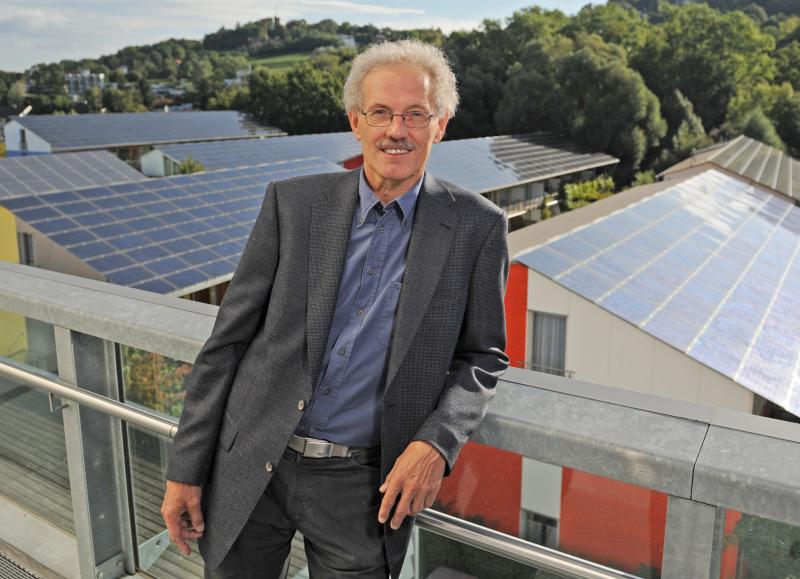
© Patrick Seeger/DBU